This site documents historical Chinese folk customs for cultural interest only. It is not advice of any kind.

Coarse Salt Warm Pack · Grandmother's Cloth Heat Pad from Chinese Homes

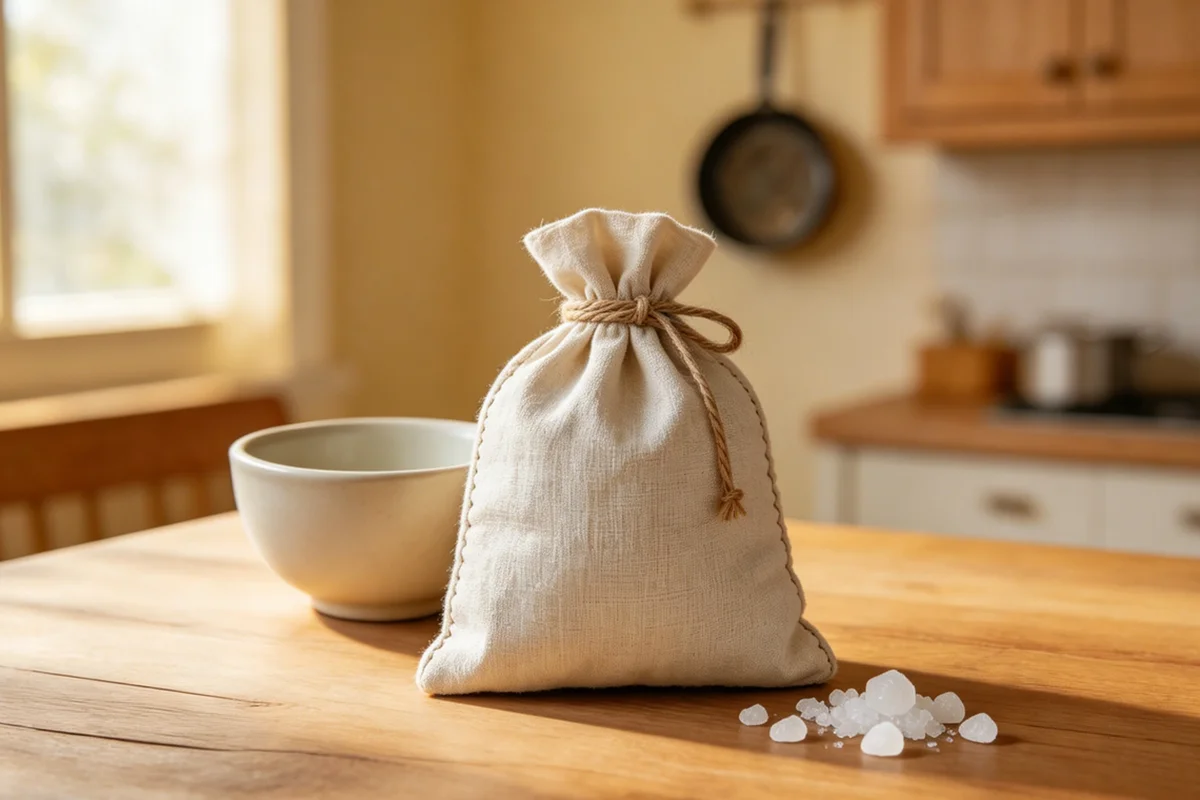
Pan-toasted coarse salt in a sewn cloth bag, placed on a stiff shoulder or chilly knees — one of the simplest warmth habits in Chinese household life. This is folk narration only, not guidance for any personal situation.

In many Chinese homes, the first response to a stiff neck after sleeping wrong, a chilly lower back on a winter morning, or cold knees after sitting on a drafty floor is not a pill or a clinic visit — it is a cloth bag filled with coarse salt, toasted in a dry pan until warm, and laid gently on the spot that aches. The method is so ordinary that most families do not have a name for it beyond "heat the salt" — four plain words that carry the weight of generations.

The practice is not unique to China — warm compresses appear in folk traditions around the world — but the specific use of coarse salt has a particular logic in Chinese kitchens. Coarse sea salt was cheap, widely available, and retained heat longer than fine table salt because of its larger crystal structure. A cloth bag of toasted coarse salt would stay warm for 20 to 30 minutes, long enough to sit with a book or watch a television program while the gentle heat did its quiet work.

Why salt, specifically

Folk reasoning — the kind passed around kitchen tables rather than printed in textbooks — holds that coarse salt has two advantages over other household heat sources. First, the crystals hold heat evenly and release it slowly, so there are no hot spots that could surprise the skin. Second, salt is inert and dry: unlike a wet towel or a hot-water bottle, a salt pack does not drip, does not leak, and does not make the skin damp. These practical qualities made it a natural choice for a household that needed a simple, reusable warmth tool.

Some families add other dry ingredients to the bag: a handful of rice grains (which also hold heat well), a few Sichuan peppercorns (for a faint tingling sensation), or a small piece of dried ginger (for aroma). These additions are regional and optional — the core habit is always the same: salt, cloth, heat.

How the habit usually travels between generations

Like most Chinese folk practices, the salt warm pack is learned by watching, not by reading. A child sees a grandparent pour coarse salt into a cast-iron pan, stir it over low heat until it begins to crackle faintly, then pour it into a small cloth bag — often a sewn square of old cotton, sometimes with a simple drawstring. The child watches the grandmother press the warm bag against her own shoulder, close her eyes, and sit quietly for a while. No explanation is needed; the gesture speaks for itself.

Years later, the child — now an adult with their own aches and stiff mornings — finds themselves standing at the stove, pouring salt into a pan, and sewing a small cotton bag from an old pillowcase. The habit arrives without fanfare, the way all the best household traditions do.

Materials

Steps

  1. Pour the coarse salt into the dry pan. If using optional additions, mix them in now.
  2. Place the pan over medium-low heat. Stir constantly with a wooden spoon to prevent scorching.
  3. After 3 to 5 minutes, the salt will begin to feel warm to the touch and may produce a faint crackling sound. Some families toast until the salt turns very slightly golden; others stop earlier.
  4. Remove the pan from heat. Let the salt cool for 30 to 60 seconds — it should feel pleasantly warm but not scalding.
  5. Carefully pour the warm salt into the cloth bag. Fill it about three-quarters full so it can mold to the shape of your body.
  6. Sew or tie the bag closed. Press it gently against the area you want to warm.
  7. Leave it in place for 15 to 20 minutes, or until the heat fades. Do not fall asleep with the pack on your skin.
  8. When finished, let the bag cool completely. The salt can be reused 10 to 15 times before the crystals begin to break down.

Notes for comfort and safety

Heat safety is the single most important consideration. Always test the bag on the inside of your wrist — the same way you would test a baby's bottle — before placing it on sensitive areas. The salt can retain surprisingly high temperatures, especially in the center of the bag, and skin can burn before you feel pain, particularly for older adults or anyone with reduced sensation.

Additional cautions:

Who should pause or seek guidance first

External heat application — even gentle heat from a salt pack — is not appropriate for everyone. You should consult a qualified professional before using a warm pack if:

When in doubt, the answer is always the same: ask the qualified professional who already knows your situation. This article describes a folk habit, not a substitute for their guidance.

The Huangdi Neijing · Suwen discusses the concept of using warmth to disperse cold and restore comfortable flow in daily life. A warm salt pack on a chilly evening echoes that ancient observation about the relationship between gentle heat and bodily comfort. Quoted purely as cultural context, not medical instruction.

— From Huangdi Neijing · Suwen (Yellow Emperor's Inner Classic)

Alternatives within the same folk tradition

If coarse salt is not available, Chinese households have several related warmth habits:

All of these alternatives follow the same safety principles: test the temperature first, keep the session short, and stop if anything feels wrong.

If you live outside China

Coarse sea salt is available at most Asian grocery stores, specialty food shops, and online retailers. Look for products labeled "coarse sea salt" or "cooking salt" — the crystals should be visibly larger than table salt. For the cloth bag, a clean cotton handkerchief or a small muslin drawstring bag works well.

As with all the habits on this site, keep expectations soft. A warm salt pack is a simple comfort — a moment of stillness and gentle heat on a tired part of the body. It is not a solution, not a therapy, and not a replacement for professional care. It is simply something grandmothers have done for a very long time, and that is reason enough to tell the story.