This site documents historical Chinese folk customs for cultural interest only. It is not advice of any kind.

Plain Rice Congee · The Comfort Bowl That Travels Through Every Chinese Kitchen

Slow-cooked rice porridge — the simplest dish in the Chinese culinary vocabulary, yet the one that appears at breakfast tables, sickbeds, and late-night suppers alike. This is folk narration only, not guidance for any personal situation.

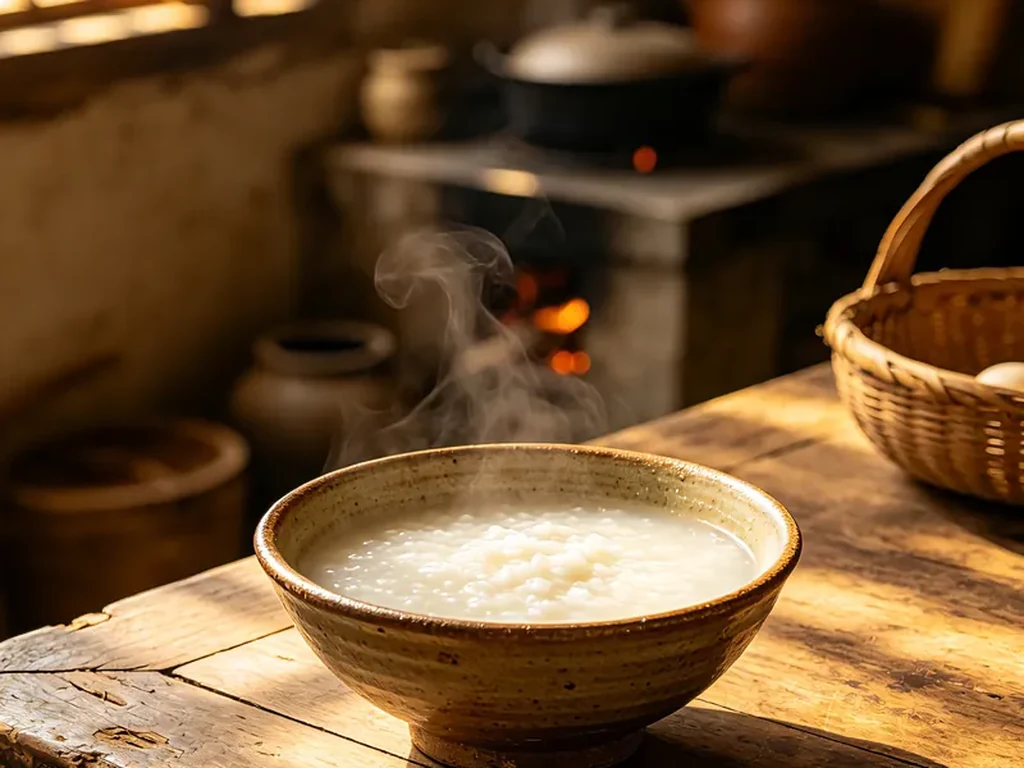
In any Chinese household, if you ask what the most comforting thing to eat is on a tired morning, a cold evening, or a day when nothing feels right, the answer will almost always be the same: a bowl of congee. Not the elaborate versions with century egg and pork that restaurants serve — just plain rice and water, cooked until the grains surrender their shape and become something between a soup and a porridge. The kind of bowl a grandmother makes without measuring, the kind that steams quietly on the stove while the rest of the house is still asleep.

The beauty of congee lies in its absolute simplicity. Rice, water, time. That is the entire recipe. Yet within that simplicity lives an enormous range of texture and feeling: some families prefer it thick enough to stand a spoon upright, others like it thin and drinkable. Some stir it constantly; others let it barely simmer for hours. The differences are regional, seasonal, and deeply personal — which is exactly why this article describes the habit in broad strokes rather than prescribing exact ratios.

A habit that crosses every occasion

Congee is perhaps the most versatile food in Chinese domestic life. It appears at the breakfast table with pickled vegetables and a fried dough stick. It appears at the bedside of someone recovering from a cold, served plain with perhaps a drizzle of soy sauce. It appears as a late-night snack for a student studying for exams, or for a grandparent who cannot manage heavier food anymore. In each case, the message is the same: this is the gentlest thing I can offer you.

The habit is so deeply embedded that many Chinese people living abroad report that the first thing they cook after a long trip home — or after a homesick evening in a foreign country — is a pot of congee. It is not about nutrition or sustenance in any calculated way; it is about the smell of rice cooking slowly, the sound of a gentle bubble, and the warmth of a plain white bowl in both hands.

How it usually travels between generations

Most people never learn to make congee from a recipe. They learn by watching. A child sits on the kitchen counter while a parent rinses rice, adds water to a pot, sets the flame low, and goes about other morning tasks. The child learns the rhythm: rinse, add water, wait, stir occasionally, wait more. Years later, standing in their own kitchen in a different city or country, they find themselves doing exactly the same thing — rinsing rice, adding water, setting the flame low — without ever having written down a single measurement.

That oral, hands-on transmission is why congee recipes vary so enormously from family to family. One household uses one part rice to twelve parts water; another uses one to eight. Some soak the rice first; some do not. Some add a tiny piece of ginger to the pot; some keep it perfectly plain. None of these versions is more "authentic" than another — they are all equally authentic, because the tradition is defined by the act of making it, not by the proportions on a page.

Materials

Steps

  1. Rinse the rice in a bowl of water, drain, and repeat once or twice until the water runs mostly clear.
  2. Place the rice in a pot and add water. A common starting point is 1 cup of rice to 10 cups of water.
  3. Bring to a gentle boil over medium heat, then reduce to the lowest simmer your stove can manage.
  4. Stir occasionally — every 10 or 15 minutes is enough — to prevent the rice from sticking to the bottom.
  5. Cook for 45 minutes to 2 hours, depending on how soft and thick you want the congee. Longer cooking yields a smoother, creamier texture.
  6. Taste and adjust: add a pinch of salt if desired, or serve plain with side dishes.

Common additions (all optional)

While plain congee is the baseline, many families add one or two small touches:

The key point is that none of these additions changes the fundamental nature of the dish. Congee with ginger is still congee. Congee with sweet potato is still congee. The habit is the bowl itself, not what you put in it.

Notes for comfort and safety

Congee is, at its core, cooked rice and water — the same ingredients in virtually every rice-eating culture. The main safety consideration is temperature: like any hot food, steam can burn, so let the bowl cool for a few minutes before eating. If you are using a rice cooker, follow the manufacturer's instructions and never overfill beyond the marked line.

If you have dietary restrictions related to rice consumption — such as diabetes, celiac concerns about cross-contamination, or any condition monitored by a qualified professional — consult that source before making congee a regular part of your meals. This article describes a folk food habit, not a dietary recommendation.

Who should pause or seek guidance first

While rice congee is one of the most widely consumed foods in the world, individual circumstances vary. If you have been advised by a qualified professional to limit carbohydrate intake, or if you have a rice allergy or sensitivity, this habit may not be appropriate for you. When in doubt, ask the same professional who guides your food choices — they can tell you whether a plain bowl of rice porridge fits into your routine.

The Huangdi Neijing · Suwen states: "Grain is the basis of nourishment." Congee — rice cooked to its softest, most digestible form — echoes that ancient idea of grain as the foundation of daily meals. Quoted purely as cultural context, not dietary instruction.

— From Huangdi Neijing · Suwen (Yellow Emperor's Inner Classic)

If you live outside China

You do not need special equipment to make congee. Any pot with a lid and a stove will work. Rice cookers with a "porridge" or "congee" setting make the process even simpler. Look for short-grain or medium-grain white rice at your local grocery — jasmine rice is a common choice. The rest is just water and patience.

If your first batch turns out too thick or too thin, that is perfectly normal. Adjust the water ratio next time. Congee forgives generously — it is, after all, the most forgiving dish in the Chinese kitchen.