The Copper Hot Water Bottle
My grandmother's hot water bottle was copper, with a screw cap tightened by hand. In winter it came out wrapped in old cotton cloth and was placed on the chair beside her bed each night.
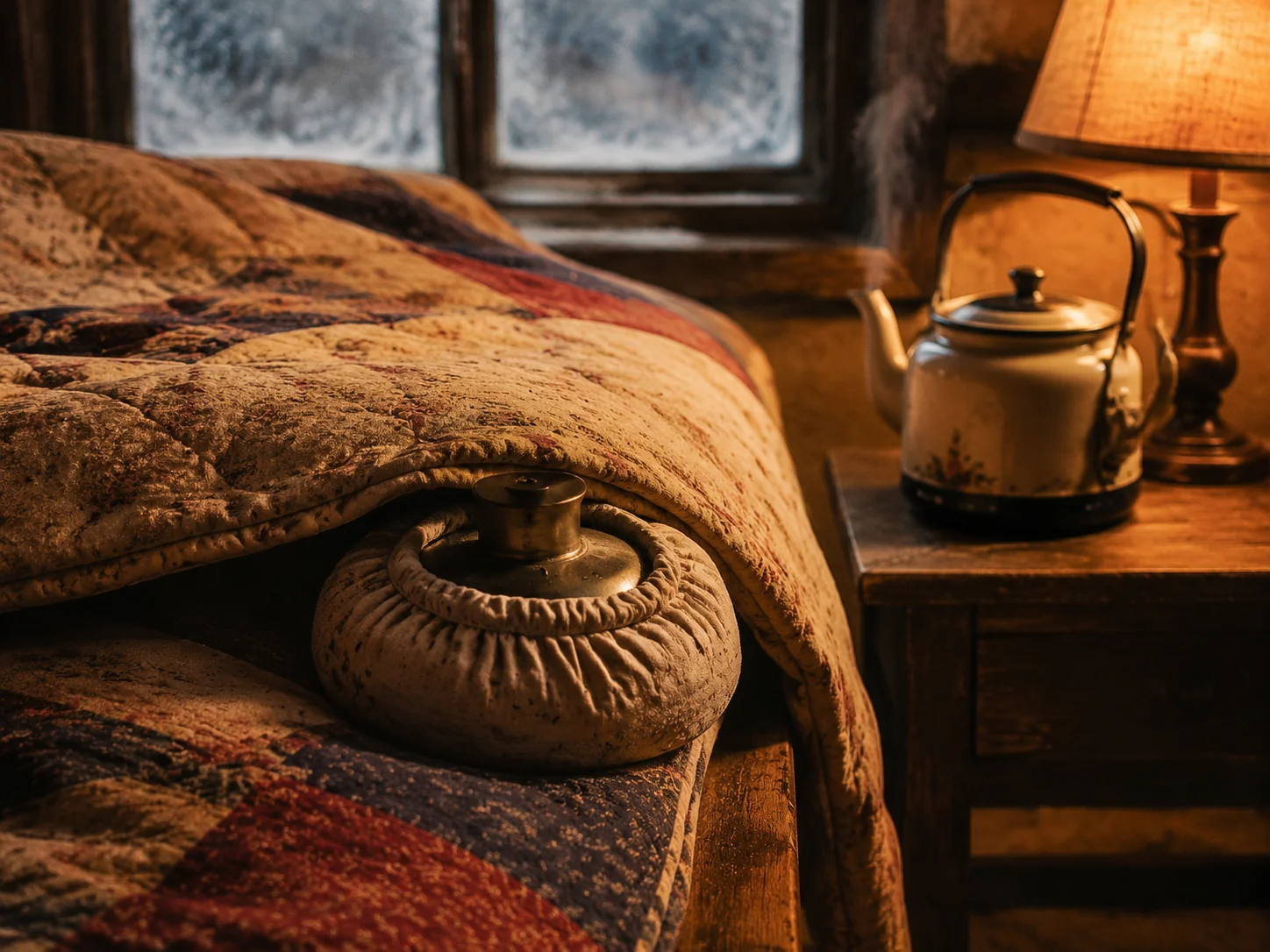
The copper bottle on the chair
My grandmother's hot water bottle was copper — flat, round, with a screw cap tightened by hand. In summer it lived at the bottom of the wardrobe under folded blankets. In winter it came out, was filled from the kettle at bedtime, and placed on the chair beside her bed, wrapped in a square of old cotton cloth. "Just boiled — too hot. Wait a moment," she would say.
The coarse-salt warming bag had to be fried in the pan and stitched shut each season. The hot water bottle only needed a kettle. But the cloth wrapper had its own rules: too thin and it burned the hand, too thick and the warmth never came through.
The chair that held three things
In a winter household my grandmother used three things in rotation: the hot water bottle for the feet, the salt bag for the knees, and a moxa roll for the back. The bottle was the simplest — fill, wrap, carry. But the cloth that wrapped it had to be folded to the right thickness, just as the older neighbor folded ginger slices into a cotton square for the belly — moving warmth from the stove to the bed.
All three took turns through the winter on the same chair. On any given night the chair held either the copper bottle or a folded cotton square waiting to be tied. The salt bag hung from a hook on the wall, where it could dry between uses.
The cloth folded in the morning
In the morning, when the bed was opened, the bottle had gone cold. My grandmother folded the cloth and set it on the bedside table — she would use it again that night. The bottle itself was wiped dry and stood on its end in the corner. The cloth, folded to its thinnest corner, was already a little threadbare, but she did not replace it.
All winter that cloth was folded in the morning and unfolded at night, until the crease lines had worn deeper than the weave. When spring came, the bottle went back to the bottom of the wardrobe, and the cloth was laid flat across the top of the folded blankets, waiting for the next winter to begin.